
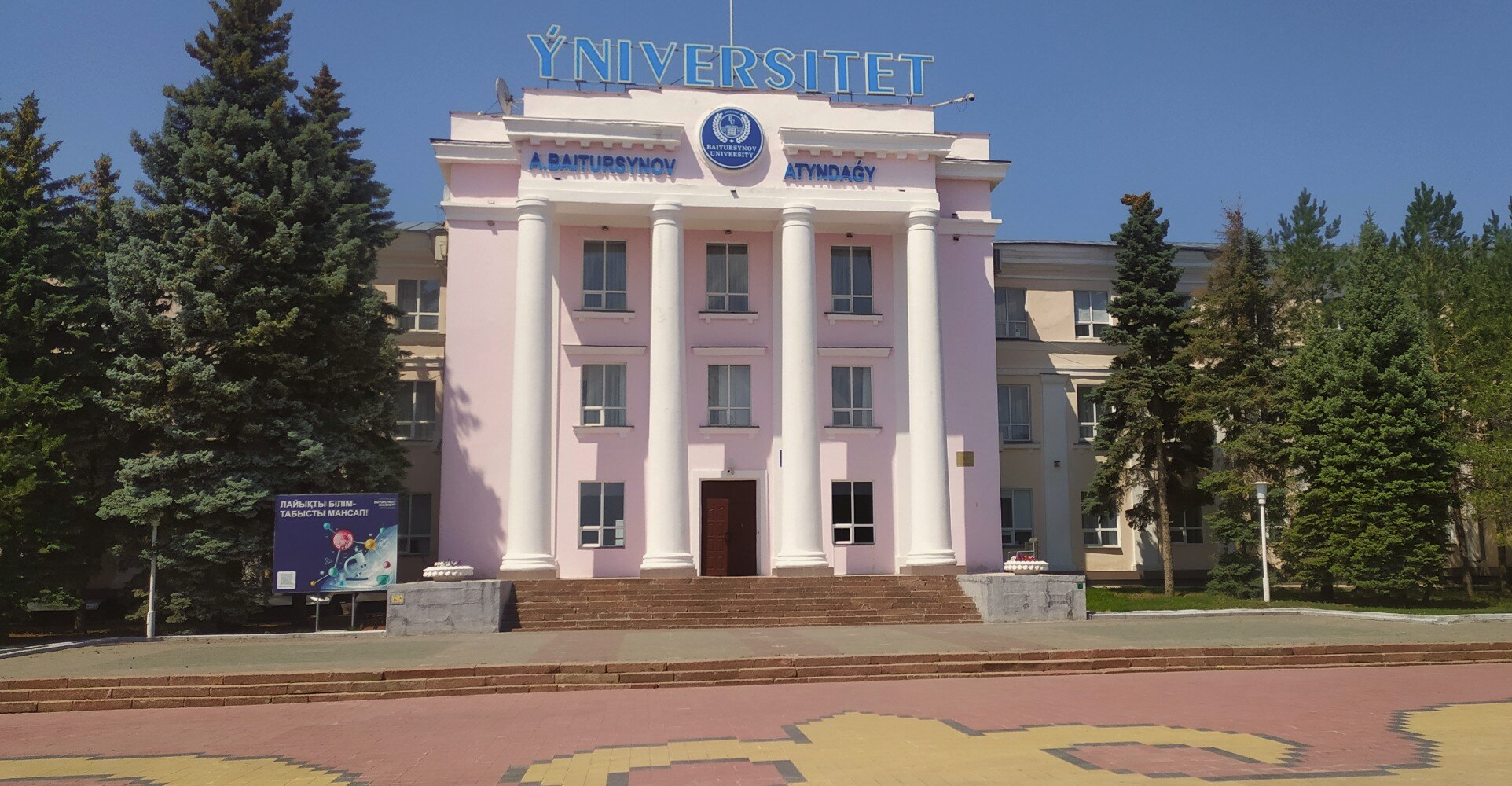
History of Foundation
On August 21, 1939, the Kostanay Teacher's Institute was organized.
The first enrollment of 240 students was completed.
In 1941, the first graduation of young specialists took place.
During 1939-1955, the institute trained about 1800 specialists.
On September 1, 1955, the Kostanay Teacher's Institute was reorganized into the Kostanay Pedagogical Institute.
In 1959, the first graduation of students who completed the full course of the pedagogical institute took place.
On December 8, 1972, the institute was renamed the Kostanay Pedagogical Institute named after the 50th anniversary of the USSR.
On September 20, 1966, the Minister of Agriculture of the USSR issued order No. 309 'On the organization of a branch of the Tselinograd Agricultural Institute in the Kostanay region'.
The first graduation of certified agronomists and livestock specialists was carried out in 1971.
By the Resolution of the Council of Ministers of the USSR dated June 13, 1978, No. 469, the Kostanay Agricultural Institute was established on the basis of the Kostanay branch of the Tselinograd Agricultural Institute.
On the basis of the Resolution of the Cabinet of Ministers of the Republic of Kazakhstan dated August 6, 1992, the Kostanay Pedagogical Institute named after the 50th anniversary of the USSR was renamed the Kostanay State University.
In 2000, the Kostanay Agricultural Institute became part of the University.
On April 1, 2004, the Kostanay Pedagogical Institute was separated from the University.
According to the resolution of the Government of the Republic of Kazakhstan dated March 13, 2018, No. 119, the Kostanay State Pedagogical Institute was renamed the Kostanay State Pedagogical University.
In 2019, the Government of the Republic of Kazakhstan issued a Resolution on reorganization by merging the Kostanay State University named after A. Baitursynov and the Kostanay State Pedagogical University named after U. Sultangazin into the 'Kostanay Regional University named after Akhmet Baitursynov'.
By order of the Minister of Science and Higher Education dated August 1, 2023, No. 377, the spelling of the name of the non-profit joint-stock company 'Kostanay Regional University named after A. Baitursynov' was changed to the non-profit joint-stock company 'Kostanay Regional University named after Akhmet Baitursynuly'.
Contingent, Admission, Graduation (2024-2025 academic year)
The student body consists of 8,372 people, including 7,884 in undergraduate and specialist programs, 421 in master's programs, and 67 in doctoral programs. Admission for the 2024-2025 year stands at 2,689 applicants (undergraduate – 2,513, master's – 155, doctoral - 21), with an expected graduation of 2,420 people.
International Students
There are 58 international students studying at the university. 54 of them are citizens of the CIS countries, 3 are citizens of Germany, and 1 is a citizen of Mongolia.
Educational Programs
Training is carried out according to a three-level model 'bachelor (specialist)-master-doctor of philosophy (PhD)' in accordance with the Law 'On Education' in 143 educational programs, of which 70 are bachelor's (specialist) educational programs across 27 areas of training, 52 are master's educational programs (scientific-pedagogical and/or profile direction) across 18 areas of training, and 21 are doctoral educational programs across 12 areas of training. Out of 143 programs, 106 are active, 22 are new, and 15 are innovative.
Educational programs are developed by academic committees, which include representatives of employers. The university has created 27 academic committees in the areas of training, which included 64 representatives of 55 organizations, of which 17 are state enterprises and institutions, 18 are educational organizations, 1 is a JSC, and 14 are LLPs. The functions of employers at the stage of educational programs development include the joint formulation of goals, competencies, and learning outcomes, the graduate model, as well as the coordination of the list and content of disciplines.
Those responsible for the processes of monitoring, evaluation, and improvement of educational programs are the director of the institute/deans of faculties and heads of graduating departments, coordinated by the registrar's office and the department of educational programs.
Employment of Graduates
The professional development of graduates includes the development of skills, knowledge, and competencies necessary for a successful career. In accordance with the Concept for the Development of Higher Education and Science in the Republic of Kazakhstan for 2023–2029, an 'upgrade' center was created on the basis of the career and employment center in December 2023. The center organizes and coordinates interaction with employers to expand social partnership, organizes job fairs, open days, and meetings with employers for graduates of various specialties jointly with employers and local executive bodies, as well as meetings with senior colleagues and successful graduates who can share their experience and give advice on building a career.
The employment of graduates in 2024 stood at 84.1%.
Faculty Information
The university has established various faculty positions: head of department, professor, assistant professor, associate professor, senior lecturer, lecturer, head of military department, deputy head of military department, head of military department cycle, senior lecturer of military department, lecturer of military department, assistant of military department. The organization standard 'Qualification characteristics of teaching staff positions' defines minimum requirements for education, academic degrees, work experience, scientific achievements, and pedagogical competencies of teachers, as well as the mandatory nature of advanced training and certification of teachers in accordance with the professional standard requirements for higher education pedagogy.
In addition, in accordance with the professional standard requirements, changes have been made to the recruitment procedure for the respective faculty positions ('Competitive filling of teaching staff positions'), emphasizing specific professional competencies, scientific achievements, experience with innovative teaching methods, etc.
The regulations on 'Planning of educational work and pedagogical load of teaching staff' have been revised; criteria for evaluating teaching effectiveness have been updated. Comprehensive criteria for teaching activities have been developed, including academic achievements of students, quality of teaching, use of innovative pedagogical technologies, performance of research activities, participation in methodological work, etc.
The job descriptions of teaching staff have been revised and put into effect starting September 1, 2024.
Corporate courses for advanced training of teachers have been approved. Training and professional growth courses are developed for different categories of teachers, including those just starting their careers and those with significant experience. Thus, a system of continuous professional growth is created. An adaptation course for newly arrived teachers has also been developed to help them integrate faster, master standards, and adapt to the specifics of the educational process.
The educational process is carried out by highly qualified faculty. Domestic and foreign scientists from universities and research organizations, and practitioners with extensive professional experience are invited to lecture on a number of disciplines.
The university has 465 staff members, 192 of whom hold academic degrees (14 Doctors of Sciences, 137 Candidates of Sciences, and 41 Doctors of Philosophy (PhD)).
Structural Subdivisions
The structure of the university includes administrative, educational, scientific, auxiliary, and support subdivisions, as well as the U. Sultangazin Pedagogical Institute, Faculty of Social and Humanitarian Sciences, Faculty of Economics and Law, Faculty of Mechanical Engineering, Energy and Information Technologies, and Faculty of Agricultural Sciences.
The educational process is supported by 29 departments and a military department. The Pedagogical Institute has 9 departments, the Faculty of Economics and Law has 4 departments, the Faculty of Social and Humanitarian Sciences has 5 departments, the Faculty of Agricultural Sciences has 5 departments, and the Faculty of Mechanical Engineering, Energy and Information Technologies has 6 departments.
Material and Technical Base
In connection with the change in legal form and the creation of a new legal entity, an inventory of real estate and land plots was carried out, which are reflected in the university's balance sheet.
The university's infrastructure includes buildings and structures for various purposes with a total area of about 90,000 square meters. These include 7 educational and laboratory buildings, the 'Bilim Ortalygy' scientific library, a Smart center, the Research Institute of Applied Biotechnology, an educational and production workshop, 3 dormitories, a network of sports facilities, a student catering plant with dining halls and cafeterias, a primary health care center, and a museum complex. The buildings comply with current sanitary, fire safety, and state educational standards.
A unified corporate telecommunications network and an extensive computer park function. The total number of laboratories is 53.
The Arta Synergy Workflow electronic document management system has been introduced.
The automation of business processes related to the educational process is carried out through the AIS 'Platonus'.
The Moodle LMS is used for educational and methodological support.
The OES proctoring system is used for online exams.
Dormitory booking is carried out online through the AIS 'Platonus'.
There is an active military department that prepares reserve officers in 5 specialties.
Scientific library users have access to domestic and foreign electronic information resources, an electronic catalog, and IRBIS 64 database resources.
In 2024, the laboratory equipment of the university was updated with new equipment worth nearly 1 billion tenge.
International Cooperation
The total number of international agreements signed in 2024 is 25. During 2024, 8 university employees underwent scientific internships in top universities under the '500 Scientists' program; the university welcomed 14 foreign scientists. As a result of work with foreign scientists, 2 articles were published in CiteScore - Q1 journals in the Scopus database, 3 articles in CiteScore - Q2-Q3 journals in the Scopus database are under review, and 6 publications are under review in recommended national journals. Under outgoing academic mobility, 29 students participated, and the university welcomed 18 incoming students.
At present, 9 double-degree programs are being implemented with the following universities: University of Minnesota Morris, Kazan Federal University, Northwest A&F University, and Vytautas Magnus University.
Accreditation
The university periodically undergoes external quality assurance procedures in accordance with the Standards and Guidelines for Quality Assurance in the European Higher Education Area (ESG-2015).
The results are posted on the official website of the University in the 'About KRU' section.
In May 2024, institutional accreditation and specialized accreditation of 56 educational programs were obtained.
In December 2024, 17 programs of the Pedagogical Institute were accredited.
Preparations are currently underway for the accreditation of 33 educational programs.
Educational Activity
The educational activity of the Kostanay Regional University named after Akhmet Baitursynuly is carried out on the basis of the general license No. KZ41LAA00035547 dated November 7, 2023.
As part of the education modernization and digitalization of the learning process, the discipline 'Fundamentals of Artificial Intelligence' has been introduced into all educational programs based on an interuniversity standard.
Under the project 'Implementation of the teacher education model and strengthening of its content', innovative educational programs 'Pre-school Education' and 'Primary Education' were developed.
To improve the quality of training specialists for the industrial sector of the region, the 'College-University' interaction program was initiated, reducing study time for college graduates to 2 years, and for applied bachelor's degrees to 1.5 years.
Dual training is implemented in 38 educational programs in the 2024-2025 academic year, with 1230 dual training agreements signed with partners such as SaryarkaAvtoProm, SSGPO, KamLitKZ, KIA Qazaqstan, and Agromashholding KZ.
The Center for Inclusive Education and Innovative Educational Technologies was established in 2023 to support students with special educational needs.
Scientific Activity
The research work of the university is carried out by scientific schools and research teams in the fields of economics, crop production, agriculture, veterinary medicine, biotechnology, IT technologies, archaeology, and pedagogical fields.
In 2024, the university hosted more than 20 international conferences, round tables, and other events. In 2024, university staff defended 9 doctoral (PhD) dissertations. Active research projects total 1.5 billion tenge in funding.
Educational and Youth Work
The goal of the university's youth work is to engage students in strengthening spiritual and moral values, supporting their self-realization, and developing competitive personal qualities.
The comprehensive plan of youth work for the current academic year is aimed at celebrating the 180th anniversary of A. Kunanbayev, the 140th anniversary of M. Dulatov, the 85th anniversary of the university, and the 80th anniversary of Victory in the Great Patriotic War.
Student Parliament, volunteering groups in 5 directions, and charitable balls play a key role in student self-governance and activities.
Achievements
The university won a major scientific funding competition for agricultural research in the region worth 4 billion tenge for 2024-2026.
The university became a leader in the number of successfully implemented international Erasmus+ projects.
Double-degree programs have been launched with Kazan Federal University (Mechanical Engineering) and Dong-Eui University in South Korea (Automotive Industry Engineering, in partnership with KIA Qazaqstan).
The King Sejong Institute of Korean Language and Culture was opened at the university.
Qostanai Hub, a branch of Astana Hub, was opened at the Smart Center in 2023, hosting over 70 IT events in 2024. The Smart Center actively implements incubation programs supporting startups and innovation.